Cinéma/TV

Cinéma/TV


Interview with Pierre Yameogo on Delwende, by Olivier Barlet

Cannes, May 2005

Wend means God in Moré. And Delwende? Literally, the translation is « I confide in God » or « I lean on God », which is almost the same. I added as a subtitle « Get up and walk », a both provocative and artistic expression. One of the centers in Ouaga has the same name. Yes, but there are other centers too: Pasnanga, Temboken, Sabou… They seem to be spreading since centers are being enlarged and there’s no law to protect women accused of witchcraft. I don’t understand why; it’s a form of collusion. How can someone be accused of « eating souls? » Some women are…
By S. Pierre Yameogo

Yameogo originally wanted to be a journalist. Realizing the political limits of this profession, he shifted to films which he perceived as freer and in each film, he has focused on one issue in particular hoping to play a part in social change. He has always avoided making message films, using humor and a rooting in everyday life to give body to his characters and that is his strength. Delwende, which deals with the thorny issue of women accused of witchcraft was initially a report made for French television news program « Envoyé Spécial » on France 2. Having to adhere to…

The 2007 Cannes festival started on May 16 with a conference on digital distribution and 16 screening-rooms were equipped with digital projectors, showing 31 films from the selection. In Africa, in the mean time, very ambitious operators are buying the rights of the films that were on the list in order to broadcast them through the new channels offered by this technology. Deep changes are occurring, which will modify our relationship to film; unless it is that relationship that is changing and film is simply adapting. Review of a festival where Africa was only visible on the margins yet nonetheless…

D'Eran Kolirin

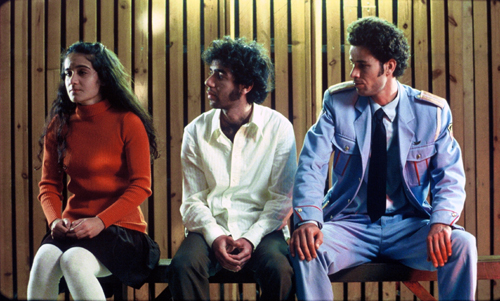
Une fanfare militaire égyptienne débarque en uniforme bleu immaculé à l’aéroport de Tel-Aviv. Elle est invitée pour l’inauguration d’un centre culturel arabe mais personne n’est venu les chercher. Dans un anglais approximatif, le groupe essaye de trouver son chemin vers la petit ville qui doit les accueillir. Mais une méprise sur le nom les conduit à une autre ville, perdue, oubliée du monde, sans hôtel. Ils y passeront la nuit, logés par les habitants. D’une belle finesse, ouvertement politique sans jamais prononcer un mot sur le conflit israélo-arabe, La Visite de la fanfare est fait de ces rencontres fortuites entre…

Les images de l'article
❮
❯
Ronit Elkabetz (Dina) et Sasson Gabai (Tewfiq)
Sasson Gabai (Tewfiq), Ronit Elkabetz (Dina) et Saleh Bakri (Haled)


De Peter Watkins

Allons enfants de la télé

Dans ce monde de clips, de SMS, de slogans et de pauses publicitaires, qui oserait encore recommander un documentaire de 3h30 en noir et blanc, avant-gardiste, dystopique et militant ? Il faut bien avouer que cette version raccourcie presque de moitié (l’original dure 5h45 !) de La Commune reste une épreuve d’endurance, qui mériterait une diffusion hebdomadaire télévisée. En effet, si on regrette de ne pas voir les 2h15 amputées, les corps ankylosés sont heureux de regagner la lumière. On voudrait aussi pouvoir débattre au fur et à mesure des nombreux débats lancés par le film, plutôt que de rester…

Les images de l'article
❮
❯


Nouvelle fournée de films documentaire issus de « Cinéma(s) d’Afrique(s) », une résidence d’écriture et de réalisation de trois mois organisée depuis 2006 à Dakar et Saint Louis sous l’égide du Festival « Filmer à tout prix » de Bruxelles et du GSARA en partenariat avec le Media Centre de Dakar et l’Ecole nationale des Arts. Les cinéastes sélectionnés vivent ensemble la fabrication de leurs films pour passer du projet au film achevé. Une tournée de trois semaines, le « Screening tour », permet aux réalisateurs d’accompagner leurs films dans des salles de cinéma et des festivals pour les confronter à différents publics. Découverte de trois…

Les images de l'article
❮
❯
Présentation par Pierre-Yves Vanderweerd de l'équipe, Adams Sie à la caméra © O.B.


La deuxième édition du Festival international du film du Kenya (Kenya International Film Festival) s’est déroulée à Nairobi du 28 septembre au 5 octobre 2007. Au-delà du grand prix attribué à Juju Factory de Balufu Bakupa-Kanyinda, le KIFF fut l’occasion de découvrir des cinématographies est-africaines tendues entre le souci de respecter les goûts du public et la nécessité de transmettre un message.

Les images de l'article
❮
❯
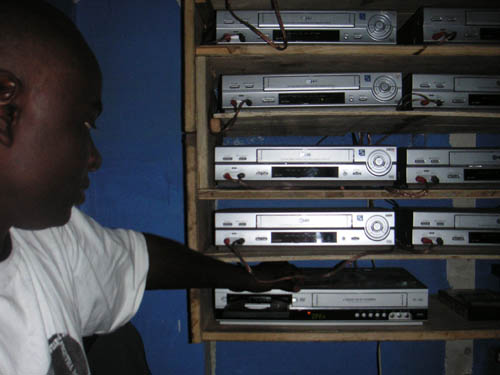
Duplication de cds au studio d'enregistrement au sein du Simba Centre.
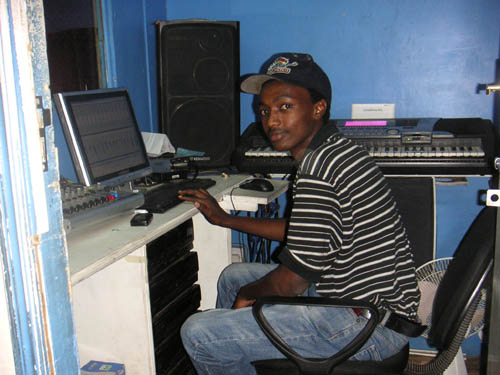
Un studio d'enregistrement au sein du Simba Centre : à l'étroit mais équipé
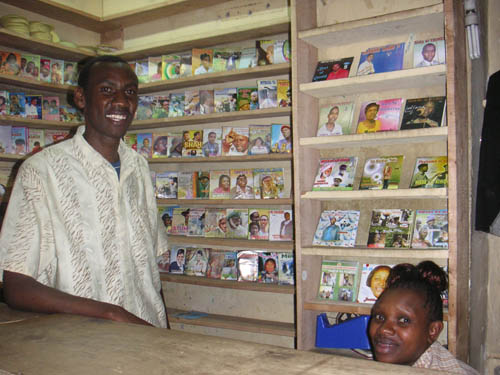
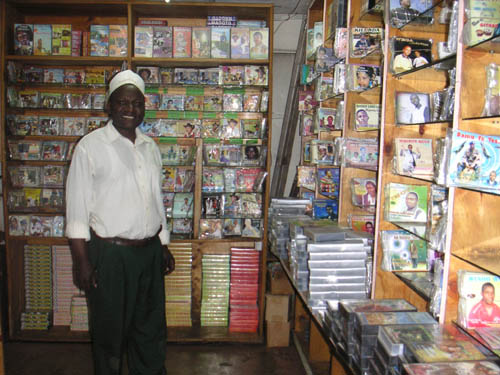
M. Chege Naf et sa femme dans leur échoppe de vcd au Simba Centre
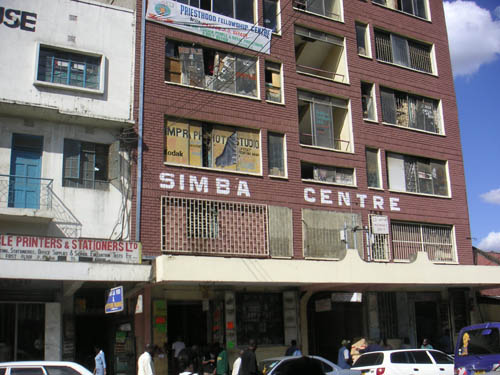
Le Simba Centre à River Road
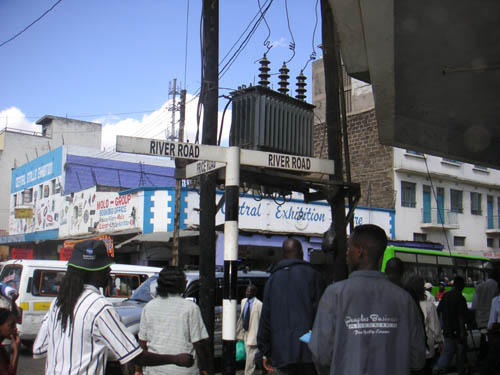
River Road
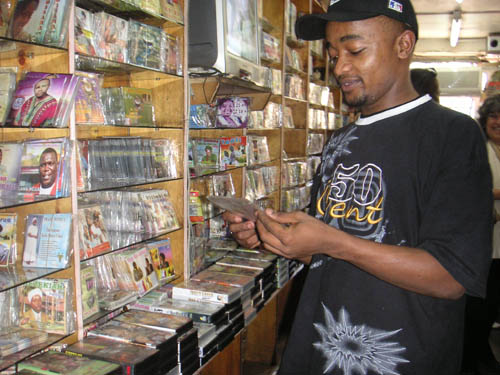
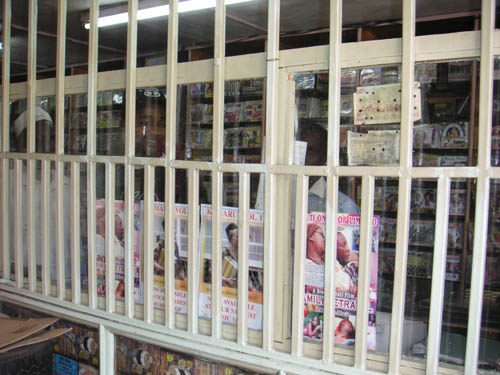
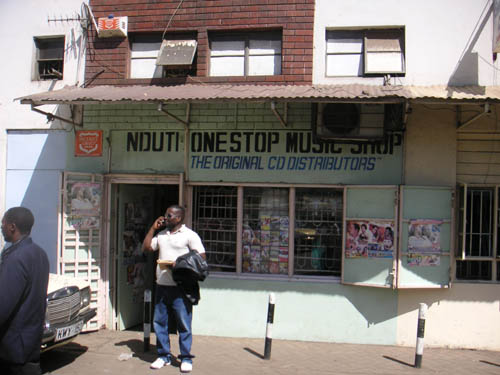
Un des vendeurs du Nduti Onestop Music Shop
à l'intérieur du Nduti Onestop Music Shop
protection à l'entrée du Nduti Onestop Music Shop
Le producteur-réalisateur S. Mburu Kimani devant le magasin Nduti Onestop Music Shop, le plus gros distributeur de vcd et de cd à Nairobi
Gaston Kaboré recueille lors de la clôture des mains d'Antoine Yvernault, attaché audiovisuel de l'Ambassade de France, le grand prix attribué à "Juju Factory" pour le remettre à Balufu Bakupa-Kanyinda
Gaston Kaboré et Charles Asiba devant le Théâtre National avant l'inauguration du festival
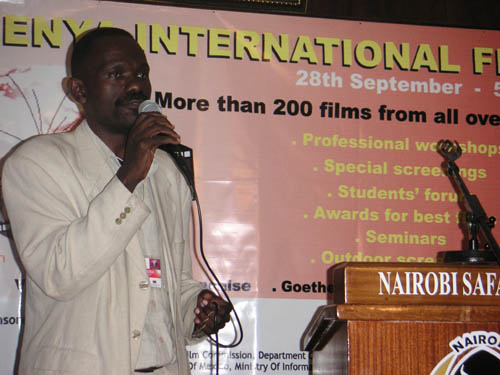
Charles Asiba, directeur du KIFF © Olivier Barlet pour toutes les photos


By Marion Hänsel

New disaster of the simplistic look that develop, despite the best intentions in the world, western directors when they take Africa as the set for their own fiction, Sounds of Sand, adapted from the novel « Chamelle » by Marc Durin-Valois and co-produced by RTBF and Arte has to be ranked among the saddest! Of course, the film is entirely in French, because of the broadcasting marketing since the youngsters are the target. As for the cast, just take a Burkinabe and a Rwandan, put in their arms some cute Djiboutian children and here you get an African family. Anyway, nothing is…

De Florent Emilio Siri

Quelque part en Algérie. L’année 1959 annonce une terrible tempête du désert. L’administration française envoie ses enfants dans un pays où la guerre n’a pas de nom. La plupart sont amoureux de la vie, d’autres sont incapables de dessiner une fleur tant leur sensibilité s’est progressivement évaporée. Au beau milieu de ce cimetière, deux hommes, idéologiquement différents, tentent de se frayer un chemin parmi ce maelström sanguinaire. Le lieutenant Terrien est une chair fraiche, sorte de bleu qui n’a pas encore humé l’odeur de la mort. Le sergent Dougnac, ancien résistant et ayant combattu en Indochine, noie sa solitude dans…

Interview by Jean-Marie Mollo Olinga and Olivier Barlet with Régina Fanta Nacro about "The Night of Truth"

Tunis, October 2004

Jean-Marie Mollo Olinga: Why make such a serious film for a first feature? I’ve always worked in urgency. And when a topic comes to me I can’t find peace of mind until I put it into images. I did not choose the topic according to its seriousness for my first feature film. I had to make that film. I was aware of the chances I was taking because it was a difficult film to make in terms of approach and artistic choice. The war in Yugoslavia triggered the story. The monstrous images showed on TV, the testimonies of raped Yugoslavian…

By Issa Serge Coelo

More than ever, the images of memory matter. Like former centuries but with an upsurge of the technical, the twentieth has piled up atrocities in the most varied situations, but always legitimized by a political aim. Therefore, what matters in films cannot to simply represent them to remind what man is capable of: we have known for a long time that there is a beast within him. Saturating images with the reminder of these atrocities only makes us desperate without mobilizing. What matters is looking for what made them possible in order to fight against the perpetuation of the barbarity.…

Interview with Jean-Pierre Bekolo about "Les Saignantes" by Olivier Barlet

Paris, July 2005

What authorizes you to refer the mevungu ritual of Beti women in film? I’m always torn between seriousness and levity. I go looking for a content, a meaning, which shapes « African » film, not in the modern meaning but mythological one too. I discovered the mevungu in the novel Le Tombeau du Soleil by Philippe Laburthe Tolra (Le Seuil / Point Odile Jacob) who teaches at the Sorbonne. We had even started to adapt the novel to the screen but the production went out of business and the project aborted. Though I’m myself a Beti, I didn’t know this rite. This…

Ousmane Sembène's Press conference at the Ecrans Noirs festival, Yaoundé, June 6 2004

As his film Moolade was presented at the Ecrans Noirs festival closing ceremony in his absence due to a flight delay; Ousmane Sembène agreed to meet the press and the audience the following morning at the festival’s village. Bassek ba Kobhio personally handed him a prize offered by PMU Cameroon, the festival’s sponsor, as well as a check representing the Ecrans noirs award of the year.

Interview with Mahamat Saleh Haroun by Olivier Barlet

Apt, November 2004

An informal meeting at the Apt festival provided the opportunity to explore the ongoing trends and stakes of African film. When referring to African film you like to talk about « a cinema of schizophrenia ». Why? It is a reference to an article I wrote entitled « From Militant to Schizophrenic cinema »: which refers to a cinema that is leaving the realm of reality to entertain, but disguised as auteur films. I am not blaming anybody, but it is important to take responsibility for that. There are no bad films, everybody is trying to do what they can, but this type of…

By Hassan Benjelloun

Benjelloun’s films are films that say more than they suggest, that point an accusing finger more than they cast an eye, would have said critic Serge Daney. Not that all is said in the dialogue, but because the whole film is built around a will for commitment. As in Jugement d’une Femme, that illustrated the movement that tried to give women their rights back, and in La Chambre Noire that dealt with repression during the dark years to show how they pushed the youth in the Islamists’ arms, he tries to shake up his country, not without taking the corresponding…

Interview by Olivier Barlet with Faouzi Bensaïdi about WWW - What a Wonderful World

The love of films plays a large part in the film; the references are both ironic and indirect. What is your relationship to films? It’s true that when looking at my biography drama occupies a large place, but for a very long time I have had an all-consuming passion for cinema. It is what pushed me to go into theater. I was a film buff in my hometown, without the slightest distance, stricken body and soul: it was a disease! I only worked in theater whilst waiting to make films! Many reviewers have indeed stressed the references to film techniques…

By Imunga Ivanga

published on 15/08/2007 A mysterious outspoken critic pirates the waves of the national radio: Liberty. His words are incantatory, a poetic harangue encouraging rebellion, a window of hope against the « tyrants who die in their beds. » He properly thwarts the police’s traps who ridicule themselves and decide to adopt tougher methods. But how to capture a phenomenon that escapes time, an intangible voice that nonetheless exists in everybody, this rebellious energy that wakes up when the people become one. Liberty is the one who makes dreams possible again. He is the uncatchable avenger of the oppressed, Robin Hood and L’Archer…

By Ntshavheni Wa Luruli

published on 15/08/2007 Wooden Camera started as a great screenplay idea: Madiba, a poor kid in a township, finds a video camera on a corpse and hides it in a wooden camera to film his surrounding without being bothered. Gradually discovering all the possibilities of the tool, he develops a new gaze, a cinematic one. His personal relationship to his daily life (family, friends, neighbors, events – a burning house or a party) and with Estelle, a revolted white young woman whom he falls in love with take on an artistic dimension. Some scenes convey a true poetry, especially when…

By Zola Maseko (South Africa)

As South Africa is seeking a still uncertain future, it is not a coincidence if a black director has chosen to concentrate on Sophiatown of the 50s. It is in this suburb of Johannesburg that after World War Two South Africa sought a new being, among an extraordinary artistic proliferation where not only genres were intermingling, combining the traditional and the modern to define new possibilities, but also men, black and white side by side as the country was sinking in the shadows of apartheid. In February 1955, 80 trucks and 2000 armed policemen started to evict the inhabitants, up…

By Mehdi Charef

Summer of ’62 is a story of torn loyalties. It is set in that type of very special moment when History senses it is time to turn a page, during this spring of 1962 before Algeria’s independence. Ali is 11, and it is through his silent eyes that we will live this moment where tensions intensify and from where are leaving those who are defeated or who have made the wrong choice. To shoot this film through a child’s eyes, Charef went to film in his hometown, Maghniya and in Tlemcen, in western Algeria. Because Ali is Mehdi Charef as…

1 … 77 78 79 80 81 … 144